
نیچے دیے گئے کارڈ پر ٹیپ کر کے مزید تفریحی انتخاب دیکھیں۔
آپ کو یہ بھی پسند آ سکتا ہے
Grade 12 Calculus
Grade 11 Functions
GRADE 7 || FIRST TO FOURTH QUARTER
Grade 1 to 3 English
CVC Words
Sineskwela (Full Episodes)
Grade 12 Euclidean Geometry
Grade 3 - Quarter 1 (All Subjects)
LEARN TO SPELL and READ | Lesson for Kids | Preschool | Grade 1 and 2 | Teacher Aya
Reading Lesson | Practice Reading English | Basic Sentences | Learn How to Read
Grade 12 Financial Maths
Grade 11 Equations
Trigonometry grade 11
Grade 11 Probability
English - Tagalog
Spelling and Reading Lesson || Spelling Tutorial || Reading Tutorial || Online Lesson for Kids
Circle Geometry Grade 11
Grade 10 Functions
You Are What You Eat
GRADE 9 MATHEMATICS
Finance Maths Lit
Playing With Language
Read and Quiz
Statistics Grade 11
تبصرے
3 تبصرے
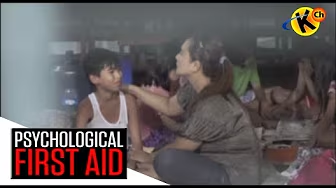
This episode talks about emphatic listening. Communication is composed of : Verbal parts (words and their meanings) Non-verbal parts (body language, silence) Words generally make up around 10% of all communication A very small amount! Subscribe to Knowledge Channel YOUTUBE Channel: http://bit.ly/KnowledgeChannel For Donors, Teachers and Learners: www.knowledgechannel.org Knowledge Channel Foundation Inc. 3rd Floor Main Building, ABS-CBN Compound, Sgt. Esguerra Ave., South Triangle, Diliman, Quezon City Email: info@knowledgechannel.org
The episode talks about what PFA is not. PFA is not counseling, psychological debriefing (people should not be asked to discuss details of events that cause distress), a session where people analyze what happened to them, nor it is about pressuring people to tell another how they are feeling and reacting to event. The aforementioned activities that do not fall within the purview of PFA are supposed to be conducted by professionals.
The episode introduces the concept of Psychological First Aid (PFA) which is a systematic, composed of helping actions, “humane and non-intrusive way of treating another individual who may be suffering and who may be needing support.” PFA is helping people feel SAFE, CALM, CONNECTED, SUPPORTED, and HOPEFUL and helping them help themselves (World Health Organization, 2011).