
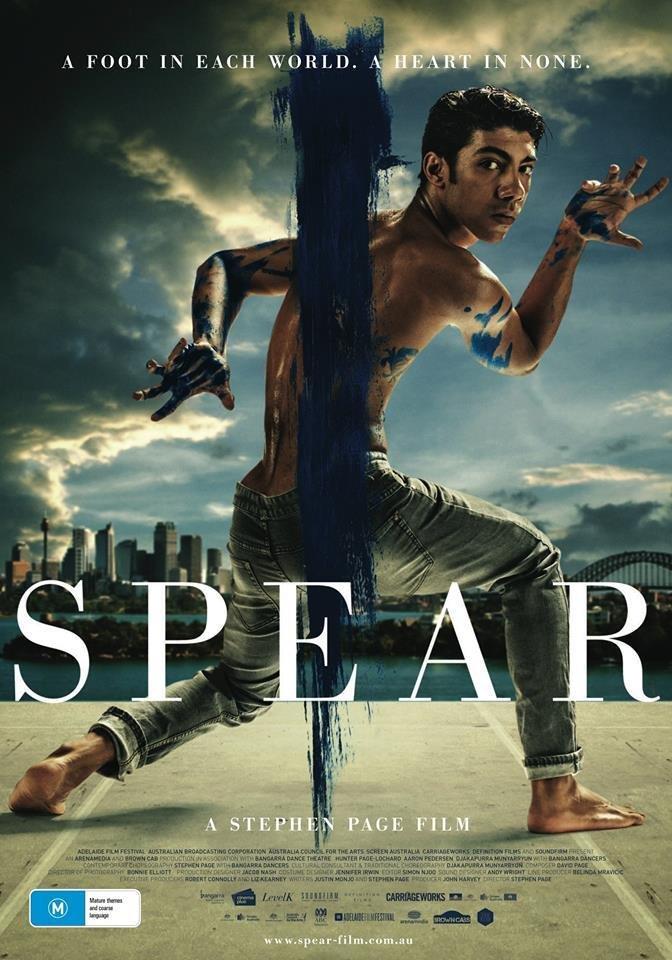
Djali,a young Aboriginal man journeys through his community to understand what it means to be a man with ancient traditions in a modern world.
Trailer
Cast
Stephen Page
Director
Hunter Page-Lochard
Djali
Aaron Pedersen
Suicide Man
Djakapurra Munyarryun
Big Man
Waangenga Blanco
Dingo Man
Kaine Sultan-Babij
Androgynous Man
Beau Dean Riley Smith
Alcohol Man
Troy Honeysett
White Man
Leonard Mickelo
Abused Man
Demala Wunungmurra
Old Man
Romeo Munyarryun
Romeo
Elmi Kris
Old Woman
Yolande Brown
Earth Spirit
Nicola Sabatino
Woman of Desire
Luke Currie-Richardson
Dancer
Rikki Mason
Dancer
Deborah Brown
Dancer
Tara Gower
Dancer
Tara Robertson
Dancer
Justin Monjo
Writer
Stephen Page
Writer
I-tap ang card sa ibaba para magpatuloy sa mas marami pang entertainment picks.
Maaari Mo Ring Magustuhan
Spear
Mystery Road
Killing Ground
Goldstone
Mystery Road
Mystery Road
Jack Irish
Janet King
Critical Incident
Mystery Road: Origin
Rake
Five Bedrooms
Preppers
Show Me the Money
Outback Ringer
Rostered On
Shaun Micallef's Mad as Hell
Trickster
One Lane Bridge
Trickster
Drag Race Down Under vs the World
All the Queen's Men
Zatima
Stranger Things
Mga Komento
4 Mga Komento
source: Spear
SPEAR is a moving film directed by Stephen Page, artistic director of Bangarra Dance Theatre. It expresses and educates on issues for Aboriginal men in contemporary Australia. The film explores initiation to manhood rituals and the themes arising are leadership, guidance, role models and identity. All the dance sequences are referenced to these themes; I was never left guessing about ambiguous abstract compositions. The film gives examples of male support outside of the usual macho paradigm. For example, the beautiful sequence shot near Dhulunbuy where dancers weave sensuously in a red desert sand circle. This is contrasted with the images of men in burnt out abandoned cars looking lost and vacant. The only scripted character in the film is Suicide Man, played with chilling naturalism by Aaron Pederson. He voices and plays out the demons threatening Aboriginal men: alcoholism, self and family disintegration and inner turmoil. The indignity of incarceration and the further violence that those institutions perpetuate is explored. It has a very strong narrative. Visually, it is a treat to behold. The combination of music, costume, lighting and the use of spatial textures creates a series of visceral atmospheres. There are many beautiful, haunting images in this film. The group dance sequences in the desert near Dhulunbuy are glorious. Midway through the film there is a satiric piece parodying the souvenir like caricatures of "Aboriginalia" using the novelty song "My Boomerang Won't Come Back" and tramped up using a vaudevillian tableau. Similarly ironic is the excerpt from the film "Jeddah" and its sugared version of Aboriginal identity, a comment on the disconnect of Aboriginal identity within mainstream Australian culture. The late David Page, the director's brother, has created an intelligent, understated soundtrack which is very dynamic and responsive. In the fight scenes he synchronizes sharp attacks with choreographed violence. At other more reflective moments he creates sheer fabric soundscapes for dancers to move within. Translating a traditional stage setting for dance to the three plus dimensions of cinema was successful. It was rewarding to be able to get detail of body shots in close ups. However the mid range shots were, for me, not as effective in composition. I wondered whether they could've been plotted better? I felt I was cut off from key parts of the body composition in the mid range shots. On one level the film is a celebration of the male physique rivaling the beauty of the male form from the Italian masters. Director Stephen Page has given us many levels of engagement in his film which is why it is so deeply satisfying. It is a multi layered poetic style of filmmaking. Ultimately, I found it both educating and moving.
Spear