
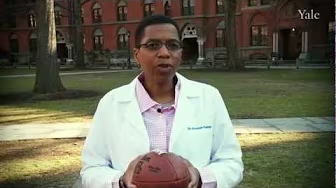
Dr. Ainissa Ramirez of Yale University brings a fun and interesting explanation to basic science concepts we see and do all the time.
نیچے دیے گئے کارڈ پر ٹیپ کر کے مزید تفریحی انتخاب دیکھیں۔
آپ کو یہ بھی پسند آ سکتا ہے
Learn English With Disney Movies
Test Your English with TV Series and Movies
CoComelon #shorts
All New Akili & Me
Learn about Safety Tips for Kids!
🏝️🗺️ Talking Hank’s Adventure Guide | Explore & Learn
Learn ABC English Alphabet with Sheriff Labrador
Numberblocks Mission HQ!
CoComelon
Kids Songs & Cartoons of Kitten Family | Kids Cartoon for Kids | BabyBus
ABC Songs for Kids - CoComelon Nursery Rhymes
CoComelon Dance Party | Dance Along & Kids Songs
Film Indonesia
SSS10 Other
ABC Jamboree by StoryBots
BabyBus | Monster Truck | Fire Truck, Police Car, Ambulance | Cars for Kids | Kids Songs
Alphabet ABC Phonics Series (From A to Z) in HD
Learn English Alphabet for Kids
Kids Songs by CoComelon
Alphabet (ABC) Songs by CoComelon
CocoMelon | Little Baby Bum | Blippi - Nursery Rhymes & Kids TV Shows
CoComelon - Happy Holidays
Educational Cartoons for Kids | Learn with Sheriff Labrador
Sheriff Labrador New Episodes
تبصرے
8 تبصرے
Liquids that respond to a magnet? This is not science fiction, but science fact. In this segment, Dr. Ainissa Ramirez, shows the wonderful world of ferrofluids, which are iron particles floating in a liquid. When a magnet is nearby, the ferrofluid makes weird shapes and increases in viscosity. Dr. Ramirez also demonstrates how you can make a ferrofluid at home using breakfast cereal.
In this segment, Dr. Ainissa Ramirez describes the science behind a tasty bit of chemistry—ice cream. She shows how to make ice cream using liquid nitrogen, which is as cold as the surface of Neptune, and describes why these cold temperatures makes ice cream, creamier. She demonstrates how our knowledge of how ice freezes can be applied to ice cream and avalanches.
Spiderman isn't the only person who can walk on walls and make webs stronger than steel. Scientists are making this possible in the lab. In this Science Xplained, Dr. Ainissa Ramirez describes the science behind making webs and walking on walls. By studying spiders, engineers can create materials that are bulletproof and can build robots that can climb the side of a building.
There has been lots of talk in the news about head injuries in American football. Using an egg and bubble wrap, Dr. Ainissa Ramirez shows how football helmets are designed to reduce skull fractures, but are poor at preventing brain injuries (or concussions). This video suggests that all of us (engineers, scientists, owners, players and fans) will have to work together to improve players' safety.
A major wardrobe malfunction in December 1812 helped cause Napoleon's army of 600,000 to return from Russia with only 10,000 men. Up until that time, Napoleon's army was unbeaten. What happened? They had to fight the elements—the cold Russian winter as well as the element tin (Sn). Tin was a major ingredient in the buttons used to hold up the soldiers' pants. Tin changes from shiny metal to gray dust when the temperature drops, in this case, causing their clothing to drop as well. Check out this Science Xplained to learn more.
Physics, anyone? In this segment, Dr. Ainissa Ramirez discusses how the strings in a tennis racket--often made of synthetic or natural materials--make the important topspin shot possible. She shows how knowing physics can give your game an advantage.
The iceberg wasn't the only culprit in the Titanic's sinking; In this edition of Science Xplained, Dr. Ainissa Ramirez demonstrates how the metal rivets that held the ship together became brittle in the frigid waters and broke apart on impact with the iceberg, likely contributing to the enormity of the tragedy.
As millions of viewers settle in to watch the Super Bowl, Yale scientist Ainissa Ramirez describes the physics behind the game and what gives a football its speed, drag and spin. Tune in now to this special Super Bowl edition of Science Xplained.