
Ketuk kartu di bawah untuk lanjut melihat lebih banyak pilihan hiburan.
Mungkin Anda Juga Suka
ABC Jamboree by StoryBots
BabyBus | Monster Truck | Fire Truck, Police Car, Ambulance | Cars for Kids | Kids Songs
Alphabet ABC Phonics Series (From A to Z) in HD
Learn English Alphabet for Kids
Learn English With Disney Movies
Test Your English with TV Series and Movies
Educational Cartoons for Kids | Learn with Sheriff Labrador
🎃🕯️🧛♀️ HALLOWEEN STORIES 2025 🕷️🧹👻
Charlie and Lola Full Episodes
How to Be a Better Human
New Compilations | Chuggington
Recent videos we think you’ll love
CoComelon #shorts
All New Akili & Me
Sheriff Labrador New Episodes
Sheriff Labrador Popular Live Stream
Kids Songs & Cartoons of Kitten Family | Kids Cartoon for Kids | BabyBus
JS 1 Science & Technology
JS 1 Business & Finance
Level 1 English | Little Fox
7 Bears | Netflix Jr
Undergraduate Study Information Ι Imperial College London
Bingo Songs! CoComelon Nursery Rhymes Mix
Hot Wheels: Let's Race | Netflix Jr
Komentar
10 Komentar
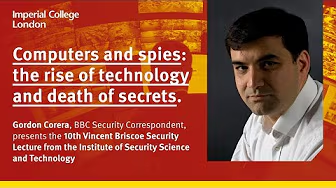
ISST's annual lecture - Vincent Briscoe Lecture
MI5's first official historian, Christopher Andrew, delivers the inaugural Vincent Briscoe Security Lecture. He explores the interaction between science, technology, and secret intelligence over the last century, from the world wars to the era of transnational terrorism.
Author of the first official history of MI6, Professor Keith Jeffery (Queens University Belfast) investigates the extent to which the profession of intelligence might be described as a science in the 2nd Vincent Briscoe Security Lecture. He also explores the role of science itself in both the working and the targeting of British intelligence operations in peace and war.
In the 3rd Vincent Briscoe Security Lecture, former US Secretary of Homeland Security, Michael Chertoff asks: when is a cyber attack a genuine act of war? What is the line between the development of offensive versus defensive cyber capabilities? How can law enforcement most effectively combat cyber crime and cyber terrorism while maintaining civil liberties and privacy?
Terrorist success depends not only on an ability to keep one step ahead of the authorities, but also one step ahead of counter-terrorist technology. But curiously, as radical or fanatical as terrorists may be, both politically and ideologically, they are technologically conservative. Bruce Hoffman (Georgetown University) explores this paradox and assesses terrorism’s ongoing technological trajectory in the 4th Vincent Briscoe Security Lecture.
Jamie Bartlett (Demos) explores dark internet subcultures, hidden encrypted websites and the people behind them in the 5th Vincent Briscoe Security Lecture. He covers the rise of citizen-led encryption systems, the crypto-currency bitcoin, the anonymous browser 'Tor', online drugs markets, and how extremist groups and criminals use the internet. Jamie explains how this world operates, and what it means for public safety and security.
In the 6th Vincent Briscoe Security Lecture, former UK Science Minister David Willetts considers ways in which a safe and secure space environment can be sustained and how we must work with international partners and the industrial and academic community to safeguard this 'global commons', which is so important to our critical infrastructure.
In the 7th Vincent Briscoe Security Lecture, NNSA Deputy Administrator Anne Harrington describes the historical development of nuclear nonproliferation, whether our technical and dialogue-based means for nonproliferation are still appropriate, and what the international policy and science community must do to maintain and further advance efforts towards nuclear threat reduction.
Commissioner of the London Metropolitan Police Service, Cressida Dick, discusses effective digital policing in the 9th Vincent Briscoe Security Lecture at the Institute of Security Science and Technology.
Professor Bill Durodie explores the contributions that the social sciences ought to make to security science and technology in the 8th Vincent Briscoe Security Lecture at the Institute of Security Science and Technology. The biggest threat we face may be an emerging cultural disconnect within society. Engaging the human dimension has never been more vital.