
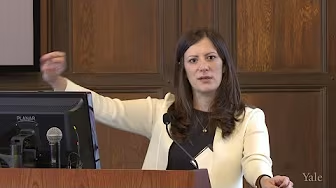
ISPS DEMOCRACY SERIES: “Are Political Lotteries the Future of Democracy?”
Around the world and in the United States, political scientists worry that democracy is failing. At a conference hosted by Yale’s Institution for Social and Policy Studies in December 2023, thought leaders from academia and the private sector gathered to learn from one another about the practicality and effectiveness of political lotteries to bolster public confidence in democracy and enhance policymaking.
اضغط على إحدى البطاقات بالأسفل لاكتشاف المزيد من اختيارات الترفيه.
قد يعجبك أيضًا
Charlie and Lola Full Episodes
How to Be a Better Human
Recent videos we think you’ll love
Berklee Holiday Videos
Learn English With Disney Movies
Test Your English with TV Series and Movies
CoComelon #shorts
All New Akili & Me
KS1 Drama
SS 1 Chemistry
SS 1 Physics
SS 3 Mathematics
New Compilations | Chuggington
Understanding the World
Top Videos
Special Videos
CoComelon Lane | NEW Netflix Kids Show
ABC Videos: Write the Letter - Alphabet Writing Lessons for Children
CoComelon | Netflix Jr
Introduction to Artificial Intelligence (AI)
Kids Songs by CoComelon
CoComelon
Alphabet (ABC) Songs by CoComelon
CocoMelon | Little Baby Bum | Blippi - Nursery Rhymes & Kids TV Shows
التعليقات
6 تعليق
Ali Cirone of Yale ISPS and Cornell moderates a panel discussion on political lotteries with Federica Carugati of King’s College London, Dmitri Landa of New York University, Philip Lindsay of Bard College’s Democracy Innovation Hub, and Kris Rose, the head of governance insights for Meta. They discuss the role of technology in improving and complicating public participation in governance, the idea of replacing elections with a system of randomly selecting government representatives, and the need for social science to continue evaluating the scope and types of current real-world experiments in citizen deliberative democracy, among other topics.
Christian Grose, professor of political science and public policy at the University of Southern California and academic director of the USC Schwarzenegger Institute for State and Global Policy, presents his research on how California, Colorado, and Michigan use citizen commissions to draw legislative districts. He anticipates participation in citizen redistricting commissions will yield future policy actions and increased civic engagement by participants.
Brenda Van Coppenolle, a senior research fellow affiliated with the Centre for European Studies and Comparative Politics (CEE) at Sciences Po, presents her research on political lotteries in European Democratization, on Denmark’s 1848 Constituent Assembly, and through an experiment with online citizens’ assemblies. Her work asks how lotteries widen access to governance for minorities and support equality as part of legislative or democratic institutions.
Forrest Sparks, founder and director of Democratic Design & Engagement, presents an overview of deliberative democracy and the Assembly Project, a movement for a more expansive and collaborative democratic system. He describes the design and function of a civic assembly drawn from a representative sample of the public and the use of experts, advocates, and small group facilitators to deliberate on policy issues such as budgeting. He evaluates the strengths and weaknesses of participatory budgeting versus a deliberative process and discusses cases studies and lessons learned from European assemblies.
Federica Carugati, a senior lecturer in history and political economy at King’s College London, lectures about how collective governance is not a 21st century phenomenon. Drawing from archaeology, anthropology, and political science, Carugati discusses her work in building a database of societies around the world and throughout history as a body of evidence to fine theories of collective governance and tool kit of governance rules that communities online and offline can use to build more robust and resilient self-governing practices.
Alexandra Cirone, an assistant professor of government at Cornell University visiting Yale as a fellow with the Institution for Social and Policy Studies’ Democratic Innovations program, introduces the conference she organized, and presents her research, conducted with Brenda van Coppenolleof Sciences Po, assessing cases through European history in which lotteries were used in permanent governing assemblies to improve representation and prevent elite capture. In an upcoming book, the authors will show how lotteries have historically worked best in new democracies without strong parties in place to control elections.